Not long ago, lawsuits over the right to honour or to one’s own image seemed to be a matter only for celebrities and the covers of gossip magazines. The situation has changed a great deal since then, because a single defamatory comment on social media, a private photo forwarded on WhatsApp or an unauthorised recording at work can do real damage to your professional and personal reputation.
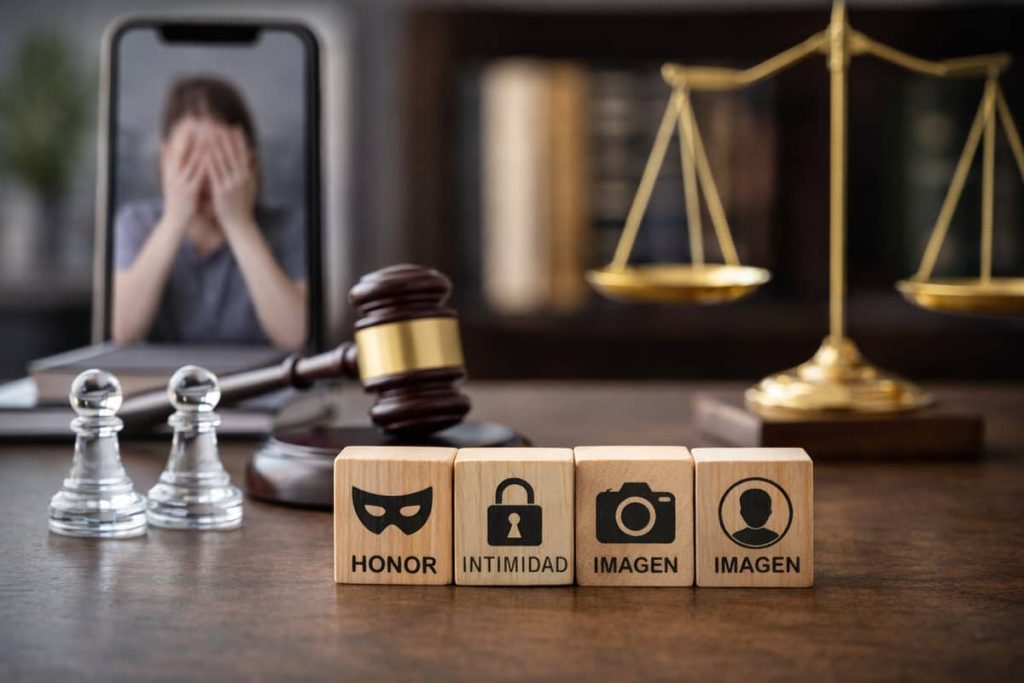
We are not talking about a moral conflict or a lack of manners. Honour, privacy and one’s own image are fundamental rights protected at the highest level by Article 18 of the Spanish Constitution (Constitución Española, CE). When someone crosses certain lines, Organic Law 1/1982 (Ley Orgánica 1/1982) allows you to take legal action.
Before starting any procedure, it is natural for questions to arise: “Can I really win, or will the cure be worse than the disease?”, “How do I prove the damage if they delete the tweet?”, “Is it worth getting lawyers involved over this?”.
The reality is that the civil system offers a specific, preferential procedure for protecting these rights, which allows you to bring a claim against individuals as well as against companies or media outlets.
Throughout this article we will look at when there is a genuine infringement, how to secure the evidence before it disappears and the steps you need to take to claim the compensation you are entitled to.
What counts as unlawful interference under Organic Law 1/1982?
For an insult or a leak to be brought before a judge, it must fit within what Organic Law 1/1982 defines as unlawful interference (intromisión ilegítima).
If someone uses your image, invades your privacy or attacks your honour without your express consent and without a law that authorises it, this is an unlawful infringement that gives rise to a right to compensation.
We are not talking about a subjective assessment of whether or not something has bothered you, but about objective, specifically defined conduct that the law expressly prohibits.
Key differences between honour, personal privacy and one’s own image
Although in practice it is common for several of them to be infringed at the same time (for example, circulating an intimate video harms both your image and your privacy), they must be distinguished because the defence strategy varies depending on the right that has been attacked:
- Right to Honour: It protects your dignity, your reputation and your standing in society. It is infringed when false facts are attributed to you, when you are seriously insulted or when value judgements are made that belittle you in front of others.
- Example: Being falsely accused of a crime on Twitter, or a media outlet publishing, without evidence, that your company swindles its customers.
- Right to Personal and Family Privacy: It shields your “secret sphere”, everything you keep away from public knowledge in order to guarantee yourself a reserved space.
- Example: The disclosure of your medical history, details of your sex life, family conflicts or the publication of private WhatsApp conversations.
- Right to One’s Own Image: It is the power to control your physical appearance. It allows you to prevent others from capturing, reproducing or publishing your image (photo, video or even your voice) if you have not given permission.
- Example: A brand using one of your Instagram photos for an advert, or someone filming you in the street to make fun of you on YouTube.
Conduct that amounts to an actionable infringement of fundamental rights
Both the law and case law have identified specific actions that, save for very well-justified exceptions, can be claimed for through the civil courts:
- Regarding privacy:
- The use of listening or recording devices (hidden cameras, microphones) to gain access to people’s private lives, even if the material is never published.
- The disclosure of facts about someone’s private life that affect their reputation, as well as publishing letters, emails or private messages (WhatsApp, Telegram) without the consent of those involved.
- The disclosure of private information learnt through professional activity (the typical case of a doctor or lawyer who reveals a client’s intimate details).
- Regarding one’s own image:
- Capturing, reproducing or publishing your image at moments of your private life or in private places (inside your home, in a bathroom, etc.).
- Using your name, voice or image for advertising, commercial or similar purposes without your prior consent.
- The circulation of intimate videos or images (sexting or revenge porn). It is important to stress that, even if you sent that content voluntarily to a specific person, this does not imply consent to circulate it to the world.
- Regarding honour: The attribution of facts or the expression of value judgements that harm a person’s dignity, damage their good name or undermine their self-esteem. Smear campaigns on social media fall squarely within this category.
Legal limits: Conflict with freedom of expression and information
Can a journalist publish something about me if it is true? Can I criticise a politician on social media?
The rights to honour, privacy and one’s own image are not absolute, because they clash with Article 20 of the Constitution (freedom of expression and information).
To determine whether an interference is unlawful or is protected by press freedom, the courts carry out a balancing exercise based on three criteria:
- Public interest: The information or the criticism must be relevant to society. Scrutinising how a mayor runs a town (public interest) is not the same as airing the love life of an anonymous neighbour (gossip with no legal protection).
- Truthfulness: This is the cornerstone of freedom of information. If facts are published, they must be true or, at the very least, the person reporting them must have acted with due diligence to check them. Rumour is not protected. If the information is false, the right to honour prevails.
- Proportionality and absence of insults: Freedom of expression protects criticism, even when it is scathing or hurtful, but it does not cover gratuitous insults (humiliating remarks). If personal insults that add nothing to the debate are used to criticise someone’s professional conduct, this is considered an unlawful interference.
Get in touch
Need help?
Legal routes for bringing a claim for infringement of rights
Below we break down the three main routes available in Spain, their nuances and when it makes sense for you to choose each one.
The civil route: Judicial protection and redress for the damage caused
This is the most common and flexible option. It is based on Organic Law 1/1982 and its aim is to make good the damage that has been done to you.
What can you obtain?
- Immediate cessation: The judge orders the removal of offensive photos, videos, tweets or news items and expressly prohibits them from being circulated again.
- Financial compensation: It covers both non-pecuniary damage (suffering, anxiety, loss of reputation) and pecuniary damage (actual loss of contracts or clients).
- Publication of the judgment: You can demand that the ruling against the defendant be published in the same media outlet or social network where the offence took place, a key measure for clearing your name publicly.
Advantages:
- It allows you to apply for urgent interim measures (medidas cautelares) to stop the content from spreading even before the trial is held.
- It is usually the most effective route for obtaining substantial compensation, as civil awards tend to be more generous than criminal ones.
- You have an expiry period (plazo de caducidad) of 4 years from the time you could have brought the action, which gives you room to build your evidence properly (although in these cases, speed always works in your favour).
The criminal route: When the interference becomes the offence of insult or defamation
This route is reserved for the most serious attacks on honour.
For a criminal judge to admit the case, the conduct must fit exactly within the Spanish Criminal Code (Código Penal):
- Defamation (calumnias): Falsely accusing someone of committing a crime (e.g. “So-and-so is a thief who has his hand in the till”).
- Serious insults (injurias graves): Statements that seriously harm a person’s dignity or damage their good name. They must be objectively serious and made with a clear intention to cause harm (animus iniuriandi).
The right of rectification as a preliminary or complementary step
If the blow comes from a media outlet (online press, radio, TV), Organic Law 2/1984 (Ley Orgánica 2/1984) gives you the right of rectification.
It allows you to require the editor of the media outlet to publish your version of the facts in order to correct inaccurate information.
Here you do not need to prove that you have been unlawfully defamed; it is enough to show that the information is wrong and harms you.
Deadlines and strategy:
- You must send it by certified letter (burofax) within 7 calendar days of the publication.
- The media outlet is obliged to publish your rectification within 3 days, with the same prominence as the original news item and without adding any comments.
If they publish the rectification, you limit the damage quickly. If they refuse without justification, that refusal is very valuable evidence of bad faith for a future civil claim.
Calculating compensation for non-pecuniary damage and losses
When you are thinking about suing, the first question is inevitable: “How much money are we talking about?”.
Unlike what happens with road traffic accidents, there is no official scale with fixed rates for interference with honour, privacy and one’s own image.
However, Organic Law 1/1982 works in your favour. This means that if you prove to the judge that there has been an unlawful interference, you are automatically entitled to compensation.
You do not need to prove that you have fallen into depression or that you have lost money (although if you can show it, the amount will go up). The final figure is set by the judge at their discretion, taking into account the specific circumstances of your case.
Criteria for assessing the amount of compensation
For the compensation to be fair and not merely symbolic, the courts assess two broad categories of damage that you can claim together:
- Non-Pecuniary Damage: It covers suffering, distress, anxiety and personal loss of reputation. Putting a price on pain is complicated, so judges usually look for reference points in previous judgments. Here it is very useful to provide psychological reports or evidence of medical treatment if you have them, as they help to make that damage tangible.
- Pecuniary Damage: This is the real, tangible financial harm. It breaks down into:
- Actual loss (daño emergente): The expenses you have had to bear because of the conflict (notary, lawyer, psychologist, costs of removing content online).
- Loss of earnings (lucro cesante): The money you have stopped earning. For example, if that smear campaign cost you your job, led to contracts being cancelled or drove customers away from your business.
Seriousness of the harm and reach of the medium as decisive factors
The judge will use these two multipliers to calibrate the final figure, raising or lowering it according to the impact:
- Reach: Reach is everything. The damage caused by a comment in a WhatsApp group of 5 people cannot be compared with that of a viral TikTok video with millions of views. The larger the audience, the greater the loss of reputation and, therefore, the higher the compensation.
- Tip: Save screenshots of the metrics (views, “likes”, shares) before the content is deleted. They are the evidence of its real reach.
- The seriousness of the harm: It depends on how sensitive the exposed information is. Touching on health, sex life, minors or accusations of crimes is punished much more severely than professional criticism, however harsh it may be. Persistence also counts; for example, if the content has been indexed on Google for years, the damage is ongoing and the redress must be greater.
The profit obtained by the infringer from the unlawful interference
If a media outlet, a website or an influencer has made money by publishing your image or your personal information (through advertising, copy sales or monetised visits), that profit must be reflected in your compensation.
Common cases of infringement on the internet and in credit reference files
Although the Organic Law dates from 1982, the reality in the courts today is digital. The vast majority of current claims arise on the internet or in automated databases.
You no longer need to be famous to find yourself caught up in this; having a mobile phone line or a social media profile is enough.
Below we analyse the three most common scenarios in which judges usually side with the victim and award compensation.
Claims for wrongful inclusion in debtor files such as ASNEF
This is the number one reason for right-to-honour claims in Spain.
A company placing you on a credit reference file (such as ASNEF, Equifax or BADEXCUG) without strictly meeting the requirements is an unlawful interference with your honour. They label you a bad payer and damage your financial reputation.
For the inclusion to be lawful, it is not enough that you owe money.
It is considered wrongful and can be claimed for if any of the following occurs:
- The debt is disputed: If you have challenged that invoice (for example, an incorrect telephone charge) and there is a genuine dispute, the company cannot use the file as a means of pressuring you into paying.
- No prior notice: The law requires the company to demand payment from you and warn you of the inclusion. If you find out that you are on ASNEF because the bank turns down your application for a card or a mortgage, there is already an infringement.
- The debt does not exist or has already been paid: It seems obvious, but mistakes happen and many companies take too long to remove the data after receiving payment.
Publication of photos without consent on social media and websites
Here we enter the territory of the right to one’s own image. Having a public photo on your Instagram profile does not give anyone permission to take it and use it wherever they like.
We distinguish three classic situations that lead to a claim:
- Unauthorised commercial use: A company takes your photo from social media to illustrate an article or an advert. As there is a profit motive, the compensation goes up (it includes what they should have paid you as a model).
- Circulation by third parties: Friends, colleagues or strangers who upload images of you in compromising or private situations without asking your permission.
- The case of minors: Here the protection is watertight. Schools, sports clubs or relatives who publish photos of children without the express consent of both parents run the risk of serious penalties.
Disclosure of private data or facts relating to private life
This section concerns your privacy. The internet has made doxxing (publishing personal data in order to harass someone) and the viral spread of personal secrets much easier.
The following are considered an unlawful interference:
- Screenshots of conversations: Posting screenshots of WhatsApp or Telegram chats on social media (Twitter, Facebook) without the other party’s permission. Even if the content is true, it belongs to the private sphere.
- Sensitive data: Publicly revealing a person’s state of health, bank details, home address, ideology or family conflicts.
- Internal employment information: A former boss or colleague posting the reasons for a dismissal or disciplinary sanctions on LinkedIn or in forums.
Requirements, evidence and deadlines for bringing the claim
Being right is not enough to win a case; you have to prove it. In proceedings for the protection of honour, privacy and one’s own image, the burden of proof lies with you.
Many legitimate cases end up being dismissed not because there is no damage, but because of a lack of solid evidence or because the deadlines were allowed to pass.
Here is a roadmap for checking whether your case meets the procedural requirements before you go to a lawyer.
Documents needed to prove that the interference took place
The most classic mistake is to rely entirely on a simple screenshot taken on your mobile phone. The courts know that digital images are easily manipulated, so their evidential value is very limited if the other party challenges them.
To make your claim watertight, you need rigour:
- Certified digital evidence: Ideally, you should have a notarial record of facts (acta notarial de presencia) drawn up (the notary (notario) browses the website and attests to its content). If you are looking for something quicker or cheaper, use time-stamping services (digital trust service providers) that certify the URL, the content and the exact date. Do it before anything is deleted.
- Proof of the damage:
- Non-pecuniary damage: Medical or psychological reports if you have suffered anxiety or depression, periods of sick leave and statements from people around you.
- Pecuniary damage: Documents showing the financial loss, such as cancelled contracts, invoices reflecting losses or letters from the bank refusing financing (crucial in debtor file cases).
- Previous communications: Keep copies of emails, direct messages and, above all, the burofaxes sent requesting the removal of the content. This shows your good faith and the inaction or bad faith of the defendant.
- In debtor file cases: You need the report from the file holder (showing where you are listed), the proof that the debt does not exist or has already been paid, and the prior complaint you made to the creditor company.
Four-year expiry period for bringing legal action
You have four years to bring your claim. Once that time has passed, the action expires and you lose the right to claim anything, however serious the offence was.
The period starts from the time you could have brought the action. In practice, this means from when you became aware of the interference and knew who was responsible.
Standing to sue: Who can seek judicial protection
Although the general rule is that the affected person brings the claim, there are important nuances depending on the case:
- Natural persons (individuals): If you are of age and have legal capacity, you act yourself, represented by a lawyer and a court representative (procurador).
- Minors and persons lacking legal capacity: The claim is brought by their legal representatives (parents or guardians). In these cases, the Public Prosecutor’s Office (Ministerio Fiscal) must intervene to ensure that the minor’s interests are protected.
- Deceased persons: The right to honour does not disappear on death. If the memory of a deceased person is offended, the heirs or the person designated by the deceased in their will can bring a claim. If there is no one, the Public Prosecutor’s Office can act (up to 80 years after the death).
Legal Persons (Companies): Companies do have a right to honour (understood as commercial prestige or reputation), but they have no privacy or own image in the personal sense. They can sue if a smear campaign damages their standing in the market.
Get in touch